
When we talk about the lifecycle of GNU/Linux distributions, we mean the different stages each version goes through.
There is no single standard that defines how long each version lasts; each project sets its own timelines and terminology. Most projects tend to follow a similar series of stages.
1. Pre-release stages
Before a version is officially released, it goes through testing stages to ensure everything works correctly:
- Alpha: an initial stage, usually unstable and intended primarily for developers.
- Beta: a more advanced version than the previous one, although it may still contain known bugs.
- RC (Release Candidate): a nearly final version; if no serious bugs are found, it becomes the stable release.
2. Stable Release (General Availability)
This is the version considered ready for production. It receives active support and becomes the basis for the rest of the lifecycle, as with Ubuntu 24.04 or Debian 12.
3. Active support or Full Support
During this stage, the system receives full maintenance: security updates, bug fixes and even, in some cases, functional improvements.
4. Maintenance stage (Maintenance / Security Support)
This is the stage when the system is well established and changes are more limited. Only security patches and critical fixes are applied, without adding new functionality. This stage is often confused with end of life (EOL), but they are not the same: the system continues to receive support, although it is more limited.
For example, in Debian, after the stable stage it is called “oldstable”, while Ubuntu, developed by Canonical, does not use a specific label for this stage.
5. LTS (Long Term Support)
This is not a lifecycle stage, but a type of release designed to last longer and provide stability. These releases are ideal for production, where a stable system is preferred over frequent changes. They usually receive prolonged support (between 5 and 10 years), divided into active support, maintenance and, in some cases, extended support.
For example, Canonical offers Ubuntu LTS releases with five years of standard support.
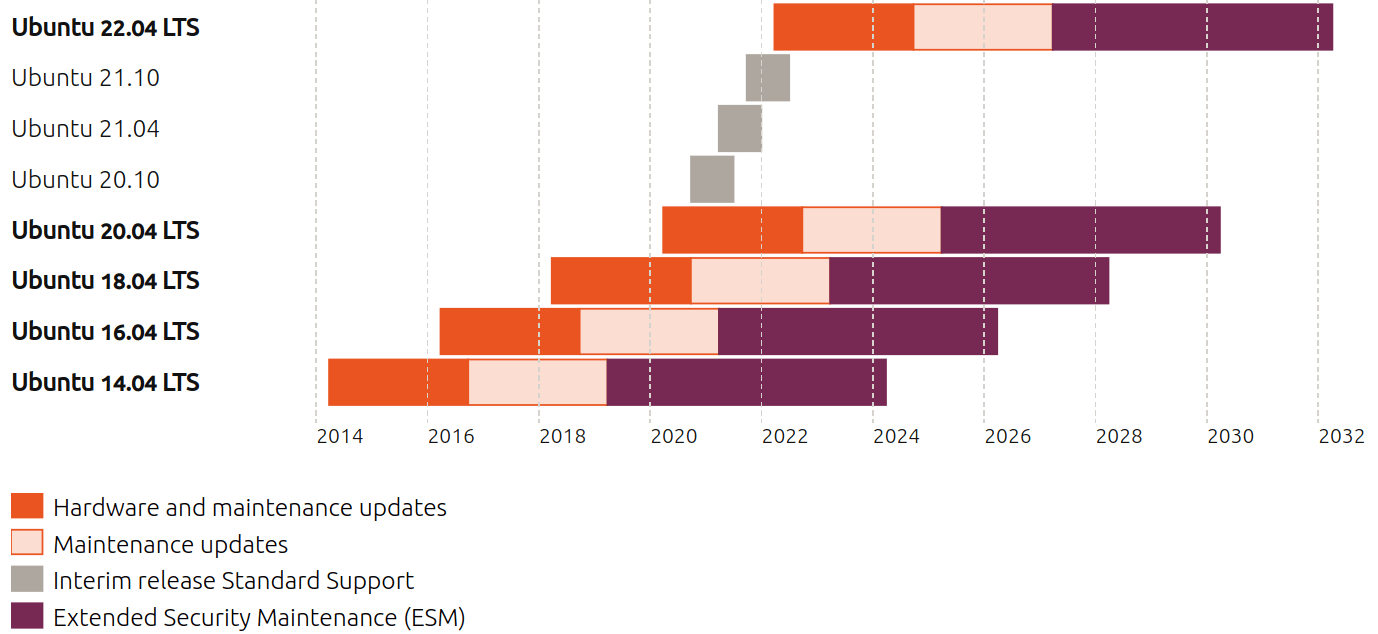
6. Extended support (ES / ESM / Extended Support)
At this stage, the system is already in its “final stage” and receives only critical security patches; no new functionality is added and full support is no longer provided.
7. EOL (End Of Life)
The “final stage” of a release. It means the system stops receiving any kind of support, including security patches, and is considered obsolete.
At this stage, vulnerabilities remain unpatched, using the system in production is not recommended, and the security risk is high.
For example, when support for a Debian or Canonical release ends, it officially reaches EOL.
Lifecycle overview
In summary, the stages are usually:
- Development: Alpha -> Beta -> RC
- GA / Stable: release ready for production
- Active Support: full support and updates
- Maintenance / Security: patches and critical fixes only
- (Optional) LTS: prolonged support and guaranteed stability
- Extended Support (ES / ESM / ELS): final maintained stage, critical security patches only
- EOL: complete end of support
Important distinction: there is no single standard binding all distributions; each project may use different names for these stages:
- Debian: stable -> oldstable -> LTS -> EOL
- Ubuntu: LTS -> ESM -> EOL
- Red Hat: Full Support -> Maintenance -> Extended Life -> EOL
- AlmaLinux / CentOS Stream: Full Support -> Maintenance -> EOL
Remember, if you have any questions about this or any other issue related to your servers at Clouding, feel free to email soporte@clouding.io We're here for whatever you need. Get in touch!